Our classes blends Hatha yoga with specific sequencing of Vinyasa (Sanskrit term for breath and movement) from Ashtanga yoga which really ignites your POWER, tones your body, helps you balance your mind and burn calories thus culminating in a beautiful holistic experience of yoga. The classes allows Beginners and all levels to be challenged in the same class. You will practice in a spacious heated modern studio at 25 deg temperature to get the best results.
Pashasana Yoga

Pashasana is the first core asana of the second Ashtanga series. It's a deep twist. In addition one has to balance.
Many face two challenges:
- First challenge is to reach the wrist with the one hand
- Second challenge is to keep the heels on the floor.
I practice this pose now since 2008 with not so much progress. It's overtime to reflect what went wrong.
1. It's important not to hook the finger. When I hook my finger the shoulder moves forward. Exactly the opposite is intended. The shoulder shall move backwards. All twists aim at making the shoulder girdle flexible, too. I got few adjustments in the last year and I was able to do it almost at once. One must only get the right instructions sometimes. I had worked in different directions.
These days I always move the shoulder backwards and so my other hand can reach the wrist.
2. The next mistake that I did was to get on the balls of my feet. When my arms were bound I rolled back and often I rolled out of the pose. This is why I use a blanket. I tried to make the blanket less high with time. Nevertheless the wished success didn't come. Then I found a YouTube video by Maria Villella. She explained that she made the same mistake for years. She recommends to get into the pose while the heels are on the floor. I think this is a good tip.
3. The next tip I got from the book by David Keil. We always think and speak of stretching the back side of the leg. Yet on the front side above the feet is a muscle, that can be engaged to support this pose. Try it, this makes a difference.
All these tiny adjustments add up.
If I had very long arms the pose wouldn't be an issue probably, but my understanding wouldn't go rather deep either.
My issues that I face when I practice are indeed opportunities to learn. The Ashtanga community is generous and shares a lot of knowledge.
A last practice on the last day of 2014
Excellent. I love it. Ashtanga yoga is my thing. It gives me so much joy in my life. I practiced today in the living room, I wanted to finish this year with a practice. And so it happened. G observed me when I did urdhva dhanurasana. To have a spectator gives so much energy.
Last Mysore class this year.
This was my last Mysore class for this year in Munich. When I arrived I saw already so many shoes in the shelf. I was late. As I have a rather long practice I knew I had to hurry. It's so good to be out of the routine from time to time. It gives energy. Routines help to manage the daily tasks, yet they can also become a corset. A too tight structure can feel like being in prison.
I started fast with my practice and kept the rhythm. I had so much energy. It was amazing.
Tomorrow is a moon day. That is we have a day off.
The pressure to write this blog is gone.
In 2009 I wrote 1421 blog posts.
In 2014 I wrote 201 blog posts,
I started writing this blog in order to stay motivated to practice yoga daily. When I discovered Ashtanga yoga I mainly practiced alone. I learned primary till navasana in a led class that was offered once a week. The rest of the series I learned from Swenson. His book was on my sofa during my first years. When ever I had he opportunity, i.e. when we traveled to the US, I went to Ashtanga yoga schools. Nevertheless I was mainly alone and I FEARED to give up the daily practice. Demanding jobs plus Ashtanga yoga brought me to my limits.
It was on a boring afternoon that I discovered that an Ashtanga community existed online. Many were blogger, too. The only teacher here in Munich 10 years back was in India for 2 months. I wanted to keep up my practice, yet doubted if I would have the energy. The one class every week pushed me through the week.
I should blog about it like all the others, I thought. This was the beginning.
Many of those early blogger and Ashtanga yoga practitioners stopped blogging. Some also gave up the practice and some both of it. Yet I also know those who still blog and still practice. :)
To write is such a strong tool to stay motivated. It's a tool to learn consciously. No matter what I want to do I also write about it. It helps to be focused.
It also seemed to me that being online was a possibility to flee. We used to live in a rather small flat, perhaps even too small. The screen was like a window to the world. I only had to switch on my PC and a much greater space opened. I felt connected with the world.
Since we moved we have more room. I don't feel anymore to create more space around me via my PC.
This blog never went through the ceiling. During the years I got more readers, yet the number is still modest. Nevertheless writing this blog had a lot of surprises. To expose in a blog requires courage. One makes oneself vulnerable. People around the globe can read what one writes. Obviously some liked it. Via that blog I got dear friends around the globe. This alone was worth all the hours spent updating it. :)
As I can go 6 times a week to a Mysore class, I don't need this blog anymore to stay motivated. I know I'll get up at 5am to go to the class. I don't have to talk me into it, it's already a habit, a daily joy.
I'll keep writing regularly because...
- I love writing, I love to express myself in words.
- Writing will support me to progress in my Ashtanga yoga. It's my way to reflect about it.
- I learned so much during the last decade, I also want to share my insights (sort of giving back).
- It's a way to stay connected with the Ashtanga community worldwide.
- I also want to write in English. It's important these days to be fluent in that language.
Today is a moon day and I don't practice.
The picture is taken in 2007.
Full house

Epiphany is over, too. The festive days are behind us. Finally.
Today the Mysore program started and it was in full swing already on the very first day. It makes a difference when a teacher studies Ashtanga yoga in Gokulam regularly. Also the teaching method is very special. The atmosphere today was so concentrated. Only the breath of the yoginis/yogis could be heard.
This is it, I thought. Indian atmosphere.
For the next 2 months we can study with Gabriel Stinga. We can thank Michael Schabort for this, our teacher here in Munich. He organised it that we can keep practicing with a very qualified teacher during his stay in Gokulam. This is so much more than one can expect. There are people who care.
This is very motivating.
I even learned a new 'trick' today: No matter if it's kapotasana or urdhva dhanurasana, one has to walk the hands closer to the feet. It can be useful to work with the fingers. I'll do this.
Despite being tired (couldn't fall asleep tonight), my body felt flexible. I enjoyed the intensity of my practice and the atmosphere.
The vinyasas

OK, the vinyasas - they are focus in the first 3 months.
The exercise on the picture is really good. One can have an 'aha-moment'. If one wants to lift up the body with straight legs. one has to pose the hands in the middle of the upper legs and not next to the hips. One must engage the bandhas. When the toes are pointed it's easier. Hands press into the floor. Inhaling and UP.
One learns to work with the shoulders because they have to move forward when the hands are placed in the middle of the upper legs.
Also when the legs are bent and close to the body, the hands reach forward. If they are next to the hips the body moves backwards and this is exact the opposite direction of what one wants.
This is in my opinion the first 'trick', the first tiny step. One has to build strength here.
One can exercise this little exercise every time, even on an office chair. No warm-up is necessary - this IS the warm-up. Hahaha.....
When jumping forward I want to finish in the above pose before lowering the body. Ha! If one can do this this dynamic movement is under control.
How one gets into a pose makes a difference

Perhaps it felt easier in the beginning, so I almost bowed forward to get into the pose. I looked down. Yet since a few days when I get into the pose I keep my head as it usually sits on the body. Eyes don't look down, but straight forward. This allows me to get deeper into this pose.
Try it. Good luck.
Twists massage the inner organs. They keep the spine flexible. They keep us young.
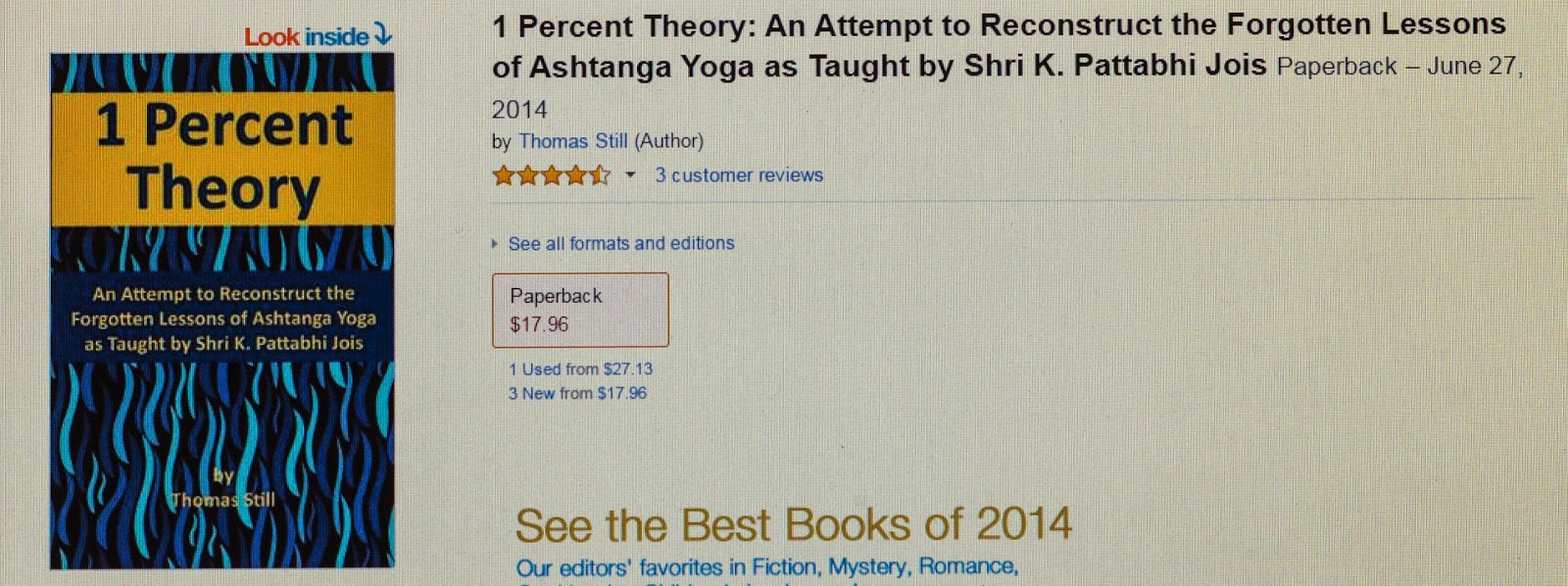
1% theory - a new book on Ashtanga yoga is on the market.

A new Ashtanga yoga book is on the market since last year and it's a very good one:
It's '1% theory' by Thomas Still.
I couldn't put down the book. Thomas did profound research in books. He also asked Manju Jois and David Williams to get answer to questions of the early years.
Thomas inquires the history of Ashtanga yoga. This chapter was very interesting. There is so much rumor. Did these leaves on which the system was 'written' exist? What was the role of Krichnamacharya? Which influence had the Indian philosophy in general? The answers in that book that were the result of profound inquiries are convincing.
I also learned more about the life of Krichnamacharya, the father of yoga. It expanded my knowledge why the teaching of Ashtanga yoga has changed over the decades.
There is also a chapter about the 8 limbs in that book. This is also so important not to forget, that Ashtanga yoga is not only about the asanas.
His chapter on 'healing' are mainly his own thoughts. I so agree what he has written. It becomes clear that yoga it's not gymnastics, acrobatic. One goal of the practice is to stay healthy, to become healthy.
Also the chapter about the 'Teaching style' brought me new information.
I highly recommend this book. It has the potential to change even how you practice.
I want to finish with a quote, '1% theory' by Thomas Still, page 143. It's a quote by Saraswathi:
"Perhaps this is just what Saraswathi, the daughter of Shri K. Pattabhi Jois, sister of Manju, and mother of Sharath meant when she said: "A stiff body has a good potential for learning Yoga. A flexible body is usually more caught up in Bhoga (pleasure)."
Yoga is more than the physical realm...... if you are interested in history, background, goals of yoga, I recommend this book.
Exploring a new shala in Hannover

Yesterday, despite the low temperatures outside I took the train to Hannover. Close to the main station is a new Ashtanga yoga school. I wanted to explore it.
I arrived very early. Quickly I saw the sign of the school. It's in the fifth floor of a building. The steps serve as a warm-up, I thought.
The teacher was already there and I was welcomed cordially. I could start my practice half an hour earlier.
I recommend to practice from time to time in another Ashtanga yoga school. In my opinion it's so much more helpful than to go to workshops. In a workshop all students are new to the teacher. When joining an existing group one is the only new student often and one gets a lot of attention.
Some of the feed-back is familiar to me already, yet I wonder why I don't change it. I have surely also bad practice habits:
1. See picture above: Hands and arms shall be in line. My feet are too far apart. My body has no room anymore to move downwards.
2. I'll take care of my feet when doing primary. They shall be vertical. It helps to press the back tendon of the leg down to the floor.
At the end after urdhva dhanurasana I should do handstand. I was glad that my body was able to balance. She stood next to me to hold me, yet for some breaths I could balance. I haven't forgotten everything. I was glad.
It's difficult to give a kapotasana adjustment if one doesn't know the body of a student. Yet it felt perfect and safe.
It's embarrassing that I cannot be in sirsasana long enough. I will work on a long long sirsasana in the next year. I'll work with a timer.
It's so wonderful to go to a studio with a committed teacher and passionate yoginis. A. helped where she could. The school will grow, for sure.
With a smile on my face I walked home. I was happy that I wasn't lazy and that I went. The next time when I'll be here in the north it will be much easier to go.
Silvester is prepared, too. We got a reservation in a restaurant. The Champagne is in the fridge. The first resolution. From midnight on till I get to bed I'll only sip Champagne. A bottle for 4 people is not too much.
Jumping forward
Jumping forward, through the arms without touching the floor with the feet - this is the goal. This vinyasa is a dynamic connection between asanas. It starts from downward facing dog.
1. First I get on the balls of my feet.
2. I move the legs close to the body and look forward to the point in front of the hands. .
3. The arms are long. This is important, if one doesn't want to injure the shoulders in the long run.
4. With the next inhaling I jump high. I think: high. The hips must be over the shoulders. the heels should move to the body. Then the body is a small parcel.
5. Bandhas are engaged!
6. Gravity forces the body to come down (fall down), often before one could move the body through the arms.
I want to jump so high that I can hold the position for several breath. Then I want to lower the body and move the legs through the arms. I have the tip to jump high and to balance for several breath on the hands with bent legs from the book by David Keil and he has it from his teacher John Scott.
Many yogis are so obsessed by handstand. I'm not. It's just another yoga pose among many. Yet this is the preparation for this pose. I don't know why, but many yoginis are so even greedy to learn handstand, but they don't want to work on the vinyasas. The practice is so perfect. It gets more difficult gradually.
I think in order to lose the fear to jump really high I have to learn to fall out of the pose. That is I have to move the head to the chest when I realize that I fall over. This must happen quickly. I postpone to exercise this, because I'm afraid. I know this is the next step!!!
Finally this dynamic movement is under control. One can stretch the legs and lower the body. With the next exhaling one can move into the next pose.
PS: This is my current knowledge. I'm also a student.
Labels:
Jumping forward Yoga
Yoga Styles- Guide to The Most Popular Types
If you want to start practicing yoga, here
is a quick guide to the basic types of yoga. While most of them are
based on the same ancient postures, each yoga style has a different
focus. Some of the yoga styles focus on strengthening the body while
others focus on flexibility. Other types of yoga focus mainly on
breathing, relaxation, and meditation.
Most of the yoga styles that were adopted in the west, were derived from the Hatha Yoga, which is a general term that refers to the physical branches of the ancient Indian philosophy. The purpose of the traditional Hatha Yoga was to achieve balance between mind and body through moral discipline and physical exercises, which are expressed by a series of asana: postures, panorama: breathing and meditation.
Western culture adopted mainly the physical aspects of the Hatha Yoga and ignored the moral aspects, usually even the breathing and meditations aspects. All the yoga styles that were derived from the Hatha Yoga share the same basic principle that mental balance can be achieved through practice of physical exercises and postures.
Each yoga style chooses to focus on different aspect.

Ashtanga Yoga
This focuses on the flow of postures in order to improve strength, stamina and flexibility of the body. During a Asthanga Yoga class, the participants jump from one posture to another. Therefore, this type of yoga is not the ideal for beginners. People who are not well fit may find it too difficult and demanding. However, if you are interested in improving your strength, flexibility and stamina and you are fit enough to deal with an hour of jumping from one posture to another, Asthanga Yoga can suit you.
This is an American development of the Asthanga Yoga that also adopted several elements from other types of yoga styles. You can find Power Yoga classes mainly in fitness and health clubs. Power Yoga focuses on strengthening the body by performing Hatha Yoga postures for a longer time to improve both physical flexibility and mental focus. Power Yoga can be a good exercise for athletes, people who practice types of fitness activities and people who want to tone their body.
A Bikram Yoga class features a series of 26 Hatha Yoga postures practiced in a heated room. It is also known as Hot Yoga. The purpose of the heat is to allow the participants to get into each of the yoga poses in a deeper and safer manner. The heat also helps clean the body from toxins promoting sweating. Bikram Yoga focuses more on the workout of the entire body, including the internal organs and less on flexibility. Bikram Yoga is not recommended to pregnant women and people who suffer from high blood pressure and heart conditions, but it can improve the physical fitness of people who recover from injuries.
This focuses on the physical alignment of the body and the accurate performance of each posture. Some of the Iyengar Yoga postures are practiced with the assistance of props such as blocks and belts that are designed to help the participants achieve the most accurate posture and to protect their bodies from injuries. Since the flows between postures are not practiced, Iyengar Yoga classes are less intense and therefore more suitable for people who are less fit. Iyengar Yoga improves body strength and flexibility and can fit people of any age and every physical condition.
Body become weaker, flabbier, and less healthy with each passing day
Getting injured sucks. The physical pain definitely contributes to the misery that an injury can inflict, but it is not the worst part of the equation. No, the worst part of being sidelined by an injury is watching all of your hard-earned progress slowly vanish before your eyes as your body become weaker, flabbier, and less healthy with each passing day.
Fortunately, an injury doesn’t have to result in the complete deterioration of your health and fitness. That, my friend, only happens by choice. The reality is, having a sore ankle doesn’t impair the use of one’s upper body and trunk. Nor does an inflamed shoulder prevent lower body activity. I think you can see where I’m going with this.

Yoga outfitter Lululemon gets the credit for breaking the barriers between gym and streetwear for many stylish New York women, who once winced at the thought of wearing yoga pants and stretch tops outside the gym. A story in the New York Times notes the trend has amped up competition among Lululemon, Nike, Under Armour, and others "to put out the next hot style." Nike's flyknit sneaker and Lululemon's Groove pants are mentioned for moving the California trend eastward.
Yoga for Pain
Is Yoga really a cure for pain? What kind of Yoga teacher should you
visit for pain management? What style of Yoga would be best, if you are
constantly feeling pain? In which cases would Yoga not be advisable for
students in severe pain? Let's look at some pain management solutions
that Yoga has to offer.

Therefore, the real dilemma, with Yoga practice, is getting a student to practice on a regular basis. Also, Yoga, much like any prescription drug, cannot promise to be a "cure-all" for every ailment. Yoga can promise to be a diversion from pain and help students to manage it better, with no adverse side effects.

Therefore, the real dilemma, with Yoga practice, is getting a student to practice on a regular basis. Also, Yoga, much like any prescription drug, cannot promise to be a "cure-all" for every ailment. Yoga can promise to be a diversion from pain and help students to manage it better, with no adverse side effects.

The lifestyle changes that occur after regularly practicing Yoga, will cause Yoga students to evaluate everything they do, and everything they eat. Yoga is not just another exercise program or some fad that just came along within the least decade. According to some archaeological findings, Yoga has been in existence for over 5000 years. Show me an exercise fad with those credentials!
Subscribe to:
Posts (Atom)